Building Digital Product Teams for the AI-Native Era

A practical blueprint for people-centric, human-AI collaboration

Table of Contents
  • Inside the AI-Native Product Shift
  • The Evolution of AI in Product Delivery (2024–Now)
  • Why AI-Augmented Delivery Starts to Break Down
  • What AI-Native Delivery Means
  • Foundations of AI-Native Teams
  • Core AI-Native Digital Product Engineering Capabilities
  • Delivering at Scale: Governance, Outcomes, and Trust
  • From Experimentation to Engineering
  • About Author
  • References

Inside the AI-Native Product Shift

This paper explores how digital product teams have evolved from early AI-assisted experimentation to a more mature, AI-native way of working. It outlines why AI-augmented approaches are falling short, and how organizations can build people-centric, human-AI collaborative teams that deliver digital products at scale with confidence, quality, and trust.

These insights reflect how CriticalRiver’s digital product teams have enhanced their delivery models while building and scaling AI-enabled platforms for enterprise clients.

1. The Evolution of AI in Product Delivery (2024 -Now)

Over the last two years, most organizations have introduced AI into product delivery incrementally. The journey typically started with individual productivity gains, progressed to team-level augmentation, and is now reaching a point where deeper structural change is required.

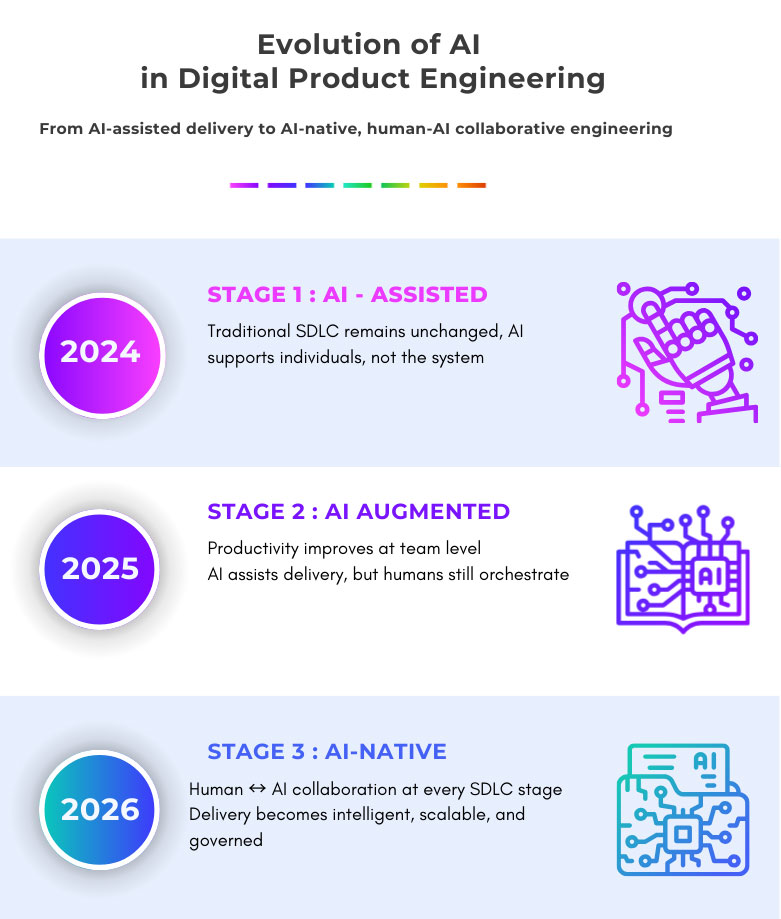
The-Evolution-of-AI-image.jpg

Figure 1 shows how AI adoption in digital product delivery has progressed from individual AI assistance to team-level augmentation and toward AI-native, human–AI collaborative delivery models. Each stage reveals why incremental AI adoption alone cannot sustain scale and quality.

  • AI-Assisted (2024): AI improves individual productivity, but delivery systems remain unchanged.
  • AI-Augmented (2025): Teams embed AI into workflows, increasing velocity but also complexity.
  • AI-Native (2026): Human–AI collaboration becomes an intentional part of how teams design and deliver products.

Speed without confidence is not maturity. Delivery models must evolve with AI adoption.

2. Why AI-Augmented Delivery Starts to Break Down

AI-augmented delivery improves output volume, but it does not fundamentally change how decisions, accountability, or quality are managed. As AI usage scales, many teams experience similar friction points.

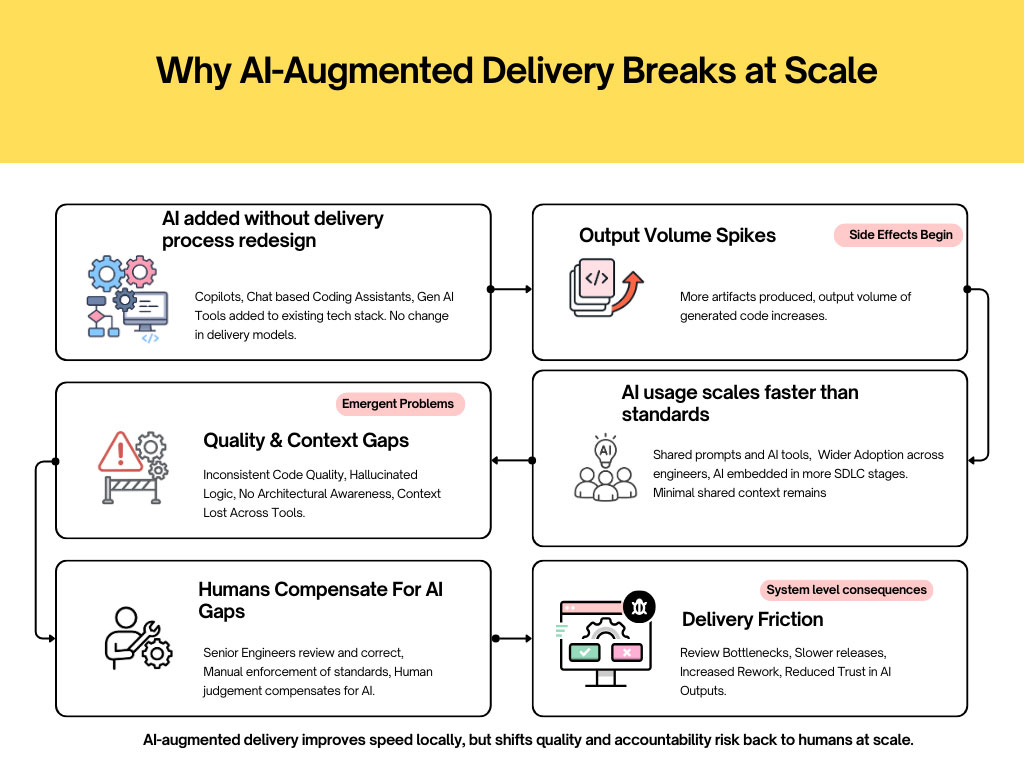
Why-AI-Augmented-img.jpg

Figure 2: The Structural Limits of AI-Augmented Delivery

This diagram shows how adding AI tools into existing delivery models increases output but also introduces systemic quality and review challenges. It shows how local productivity gains lead to global delivery risk when context and governance are missing.

Across multiple delivery programs in 2025, delivery leadership at CriticalRiver observed that teams moved faster, but senior engineers were less confident approving production releases. Common challenges observed across 2025 assessments include:

  • Inconsistent AI-generated code quality
  • Hallucinated logic and shallow architectural reasoning
  • Increased review burden on senior engineers
  • Lack of shared context and standards across teams

Industry analysis and developer community insights consistently show that while AI accelerates output, it does not guarantee production-grade reliability at scale. Notably, these challenges were consistent across different AI tools, reinforcing that the root cause lies in delivery models rather than tooling choices.

3. What “AI-Native” Actually Means

AI-native delivery is not about using more AI tools. It is about designing delivery systems where AI and humans collaborate by default, supported by shared context, clear accountability, and built-in governance.

In practice, this means treating AI-native delivery as an architectural choice for how work is organized and governed, an approach CriticalRiver has adopted across its delivery models.

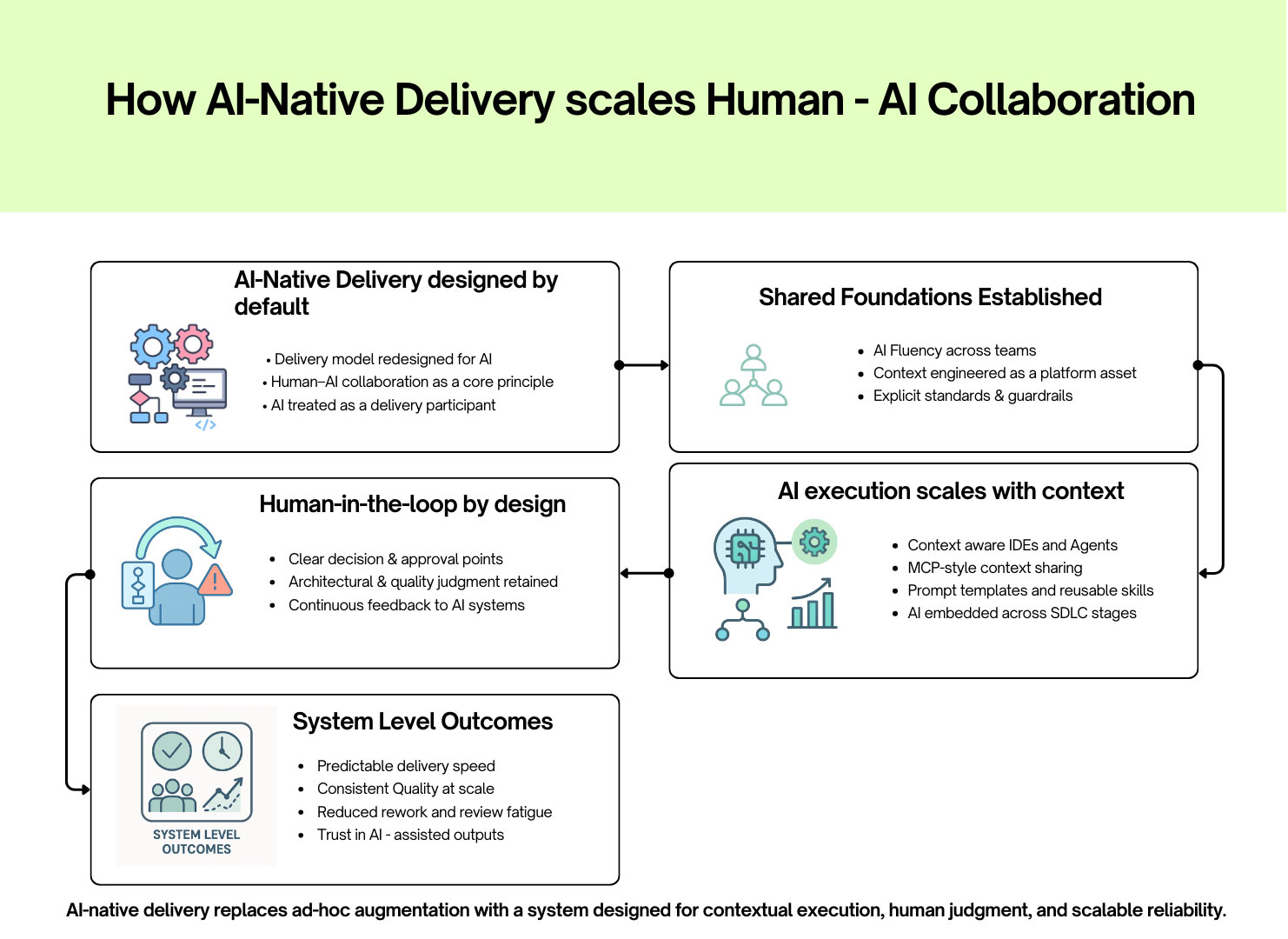
What-AI-Native-img.jpg

Figure 3: AI-Native Delivery as an Engineered System

This diagram presents AI-native delivery as a system built on people capability and engineered context. Outcomes emerge when human-AI collaboration is intentionally designed into execution, not added afterward. This model aligns with CriticalRiver’s AI-first philosophy, where intelligence is embedded into delivery, not layered on afterward.

4. Foundations of AI-Native Teams

AI-native delivery stands on two non-negotiable foundations: AI Fluency and Context Engineering.

4.1 AI Fluency – The People Capability

AI fluency is the ability for teams to collaborate with AI intentionally and responsibly while retaining human accountability.

AI-fluent teams:

  • Clearly define problems and success criteria
  • Intentionally decide what work to delegate to AI
  • Provide explicit instructions, constraints, and examples
  • Critically evaluate AI output before acceptance

AI fluency ensures that speed never comes at the cost of accountability. At CriticalRiver, this often shows up in review conversations where engineers are expected to explain why an AI-generated solution works before it is merged.

4.2 Context Engineering — The Platform Capability

AI systems cannot reliably infer organizational knowledge. Context must be explicit, structured, and reusable. We found that without shared architectural context, AI tools produced locally correct but systemically fragile solutions. By treating context as a first-class asset, teams reduce hallucinations, improve alignment, and eliminate repetitive correction cycles.

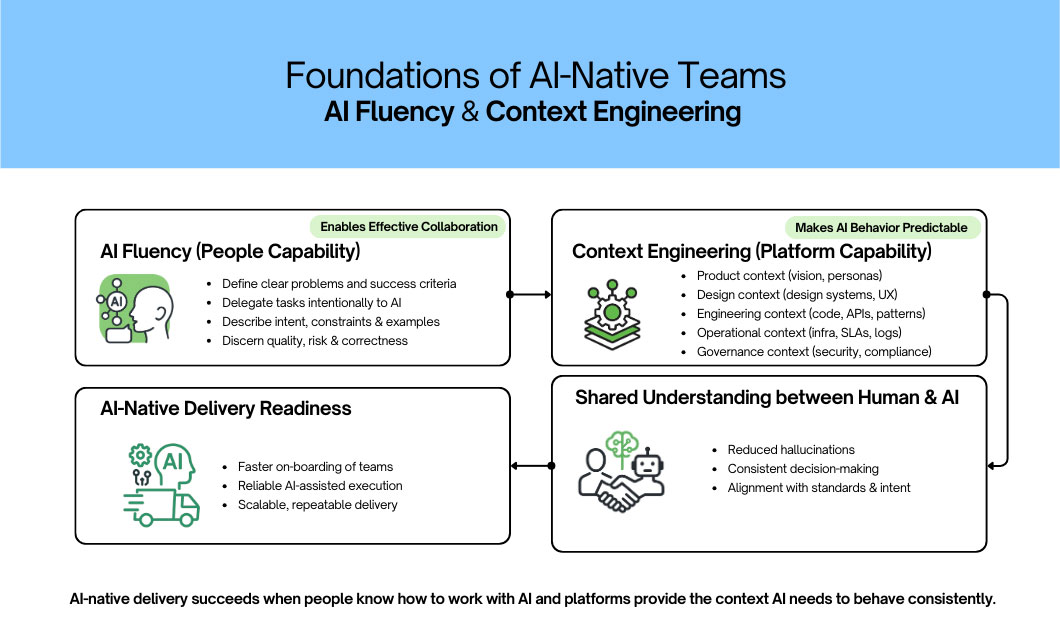
Context-Engineering-img.jpg

Figure 4: Foundations of AI-Native Teams

This diagram shows how AI fluency and context engineering work together to produce consistent, trustworthy AI behaviour. AI-native teams scale because humans provide judgment while platforms provide shared understanding.

5. Core AI-Native Digital Product Engineering Capabilities

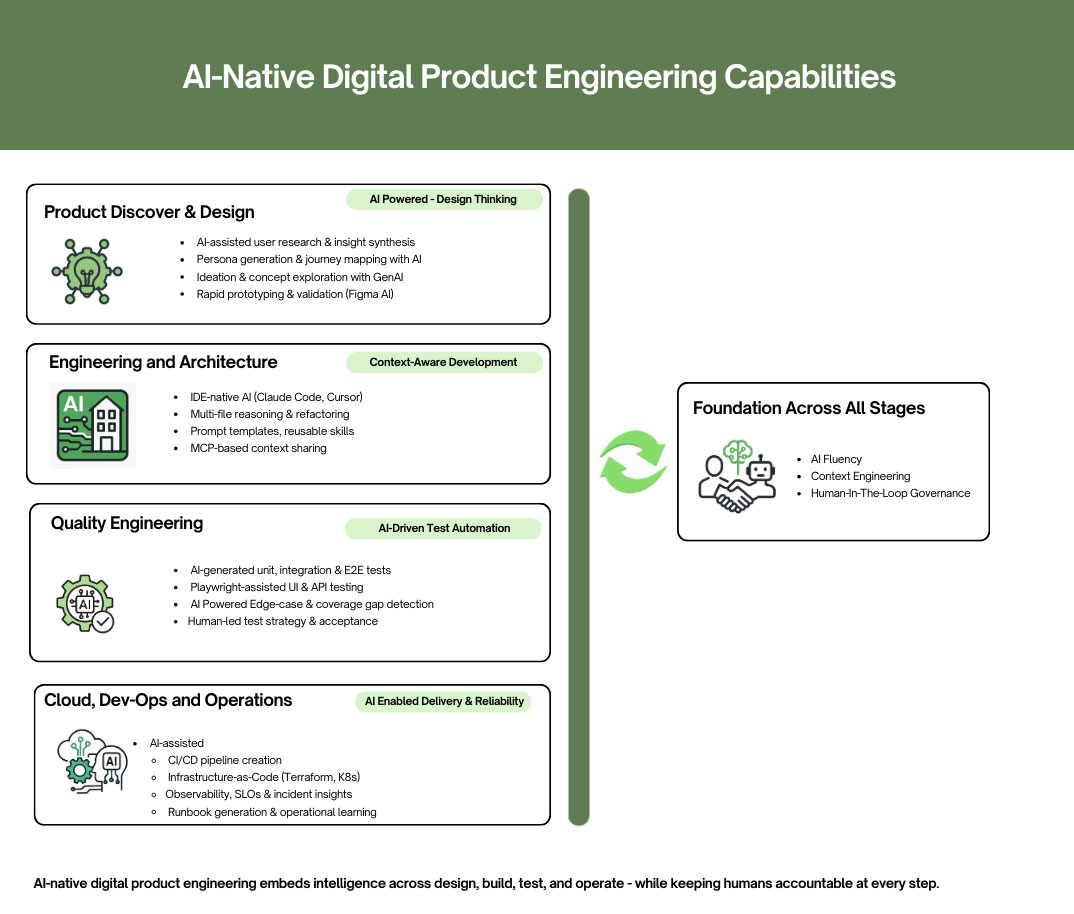
AI-native delivery spans the full digital product lifecycle, beyond coding alone. This was a critical shift for CriticalRiver teams, as early AI use was disproportionately focused on code generation.

Core-AI-Native-img.jpg
Figure 5: AI-Native Digital Product Engineering Capability System

This diagram shows how AI is embedded across product design, engineering, quality, and operations using shared context and human oversight. Read top-to-bottom as a continuous delivery system rather than isolated phases.

AI-Augmented Product Design Thinking

AI accelerates discovery, ideation, and validation by synthesizing insights, exploring design alternatives, and supporting rapid prototyping using tools such as Figma AI. Humans remain responsible for creative judgment and prioritization.

AI-Native Engineering & Architecture

Engineers work inside AI-enabled environments (e.g., Claude Code, Cursor) that understand repository structure, architectural intent, and standards. This reduced architectural drift and shortened onboarding time for new engineers. MCP-style context exchange ensures consistent behaviour across tools and agents.

AI-Driven Quality Engineering

AI supports unit, integration, and end-to-end testing, assists frameworks such as Playwright, and helps uncover edge cases and coverage gaps. Test strategy and release decisions remain human-led.

AI-Enabled Cloud, DevOps & SRE

AI accelerates CI/CD pipelines, infrastructure-as-code, observability, and incident analysis – reducing operational toil while improving reliability.

6. Delivering at Scale: Governance, Outcomes, and Trust

AI-native delivery does not trade control for speed. Governance is embedded directly into workflows through human-in-the-loop checkpoints, versioned prompts and context, and observable AI outputs.

Organizations that adopt AI-native delivery models achieve:

  • Faster and more predictable delivery
  • Higher quality and reduced rework
  • Scalable execution across teams
  • Sustained trust in AI-assisted outcomes

AI-native teams move fast because they are designed to do so safely and consistently. Trust becomes an outcome of the system, not an act of faith.

Closing: From Experimentation to Engineering

The industry has moved beyond experimentation. The next phase of digital delivery belongs to organizations that intentionally design for human–AI collaboration.

AI-native delivery is not about replacing people—it is about elevating how teams think, decide, and build together.

Let’s Continue the Conversation

CriticalRiver partners with organizations to build AI-native digital product teams—combining deep engineering expertise with an AI-first, people-centric approach.

If you would like to explore how AI-native delivery can accelerate outcomes for your teams and customers, we welcome the opportunity to continue the conversation.

About Author

Rahul-Srivastava.jpg

Rahul Srivastava

Practice Head, Digital Product Engineering

Rahul Srivastava leads Digital Product Engineering at CriticalRiver, bringing nearly two decades of experience helping enterprises modernize delivery models, scale digital products, and adopt AI-native ways of working. He focuses is on building people-centric, AI-native engineering capabilities that embed AI across the product lifecycle, while maintaining quality, governance, and delivery confidence.

Recommended References

  • AI Fluency Framework — A model for structured human–AI collaboration and capability building.
  • State of AI vs Human Code Generation — CodeRabbit report discussing quality, limitations, and comparison of AI-generated vs human code.
  • Gartner: 75% of Enterprise Engineers Will Use AI Code Assistants by 2028 — Adoption trajectory of AI coding tools in engineering teams.
  • Sonar’s industry reporting highlights that many developers use AI-generated code but don’t fully validate it, leading to “verification debt” and quality risk — relevant to AI-Augmented delivery problems discussion.

Let’s Build Intelligent Systems Together

Empowered by our Studio Leaders, we’re enabling companies to embrace AI-first innovation. Together, we build intelligent systems that scale possibilities and performance.

Let’s start a conversation.

Tell us what you’re looking to build. Our experts are just a message away.

    Preferable Date:

    Preferable Time:

    Preferable Time Zone:

    Thank you for reaching out. Our team will connect with you shortly to discuss your requirements and next steps.